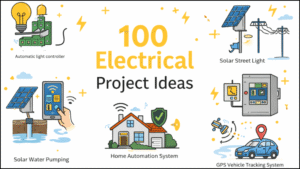
Choosing the right project is often one of the most important parts of studying electrical engineering. While textbooks explain theories and formulas, projects are where those concepts actually start making sense.
To make things easier, I’ve put together a list of 100 electrical project ideas for electrical engineering students. The goal of this list is not just to give random ideas, but to suggest projects that actually reflect real electrical engineering concepts. Some of them are simple mini-projects that help you understand the basics, while others are more suitable for final-year work or deeper experimentation.
The projects are grouped into different categories such as basic electrical systems, power electronics, motor control, renewable energy, automation, and power system protection. This way, you can quickly find ideas that match your interests or the requirements of your course.
Safety Warning: Projects involving AC mains should always use an isolation transformer during testing, and beginners should work under the supervision of a qualified professional.
Basic Electrical Project Ideas
1. Automatic street light using LDR
This project turns a street light ON when it becomes dark and switches it OFF during the day. The idea is simple but very useful in real lighting systems. An LDR (light-dependent resistor) is used to sense the ambient light level. When the light intensity drops at night, the circuit activates a relay that powers the lamp.
To build this project, the LDR can be connected to a transistor-based switching circuit or a comparator. The output of this stage drives a relay module that controls an AC lamp or LED street light.
1: Automatic Street Light on Breadboard – A beginner-friendly guide using a transistor and LDR.
2: Arduino LDR Street Light – Includes the circuit diagram and code for an Arduino-based version.
2. Automatic water pump controller
This project automatically controls a water pump based on the level of water in a storage tank. It prevents the tank from overflowing and also avoids dry running of the pump.
The system can be built using float sensors or simple water level probes placed at different heights in the tank. These sensors provide signals to a relay control circuit. When the water level drops below a certain point, the pump starts. Once the tank is full, the circuit switches the pump OFF.
Video: Relay Based Water Level Controller (No IC) – Uses float switches for a robust, non-microcontroller design.
Video2: PLC-Based Water Pump Logic – For those interested in industrial automation (Ladder Logic).
3. Battery level indicator
A battery level indicator shows how much charge is remaining in a battery. This type of circuit is useful in backup systems, small solar setups, or portable power supplies.
The project can be implemented using a voltage divider and comparator ICs like LM339 or LM324. Each comparator activates an LED at a specific voltage level, giving a visual indication of the battery charge status.
1. Simple battery level indicator using OP-AMP
4. Overload protection for household appliances
Electrical appliances can get damaged if they draw more current than they are designed for. This project demonstrates a simple overload protection system that disconnects the load when the current exceeds a safe limit.
A current sensing resistor or current transformer can be used to monitor the load current. When the current crosses the preset limit, a comparator triggers a relay that disconnects the appliance.
1. Overload protection circuit
5. Automatic room light controller
This project turns room lights ON when someone enters and turns them OFF when the room becomes empty. It helps reduce unnecessary power consumption.
The system can be built using two IR sensor modules placed at the door or a PIR sensor at the top. A small control circuit or microcontroller keeps track of people entering and leaving the room and controls a relay connected to the lighting system.
Auto room light controller without a microcontroller
6. Simple power factor indicator
Power factor is an important concept in electrical engineering, especially in industrial systems. This project helps students visualize whether the load is mostly resistive, inductive, or capacitive.
A simple design can be created using phase comparison between voltage and current signals. These signals can be processed using op-amps or comparators, then fed to a microcontroller, and LEDs can indicate whether the power factor is lagging, leading, or close to unity.
Arduino-based power factor indicator project
7. Temperature-controlled fan
This project automatically changes the speed of a fan depending on the temperature of the room.
A temperature sensor such as LM35 can be used to measure the temperature. The sensor output is fed to a control circuit that adjusts the fan speed using a triac-based regulator or PWM controller.
8. AC Voltage monitoring system
In many electrical installations, monitoring the supply voltage is important to prevent damage to equipment. This project measures the AC voltage and displays whether it is within a safe operating range.
A step-down transformer can be used to reduce the AC voltage to a safe level. After rectification and filtering, the signal can be processed using comparators or a microcontroller to indicate low voltage, normal voltage, or overvoltage conditions.
Measure the AC voltage using Arduino
9. Emergency light system
An emergency light automatically turns ON when the main power supply fails. This type of system is commonly used in homes and commercial buildings.
The project can be built using a rechargeable battery, a charging circuit, and a relay or transistor switching arrangement. When the mains supply is present, the battery charges. When power fails, the circuit automatically switches to battery power and lights up the LED lamp.
10. Digital energy meter (Basic Model)
This project demonstrates how electrical energy consumption can be measured. It helps students understand how energy meters work in homes.
A current sensor and voltage sensing circuit can be used to measure power usage. These signals can be processed using a microcontroller which calculates energy consumption and displays the result on an LCD.
Power electronics project ideas
11. AC light dimmer using TRIAC
This project controls the brightness of an AC lamp by adjusting the amount of power delivered to it. The brightness is changed by controlling the firing angle of a TRIAC.
The circuit can be built using a TRIAC, DIAC, and a potentiometer. The potentiometer adjusts the triggering point of the TRIAC during each AC cycle, which changes the voltage applied to the lamp and therefore controls the brightness.
12. DC motor speed controller using PWM
In many electrical systems, controlling the speed of a DC motor is important. This project uses pulse width modulation (PWM) to adjust motor speed efficiently.
A PWM signal can be generated using a 555 timer or a microcontroller. This signal drives a MOSFET which switches the motor on and off rapidly. By changing the duty cycle of the PWM signal, the average voltage applied to the motor changes, which controls its speed.
13. Buck converter (step-down DC converter)
A buck converter is used to reduce a higher DC voltage to a lower DC voltage efficiently. This type of converter is commonly used in power supplies and battery-powered devices.
The circuit uses a MOSFET as a switching device, along with an inductor, diode, and capacitor. A PWM signal controls the switching of the MOSFET, and the inductor-capacitor combination smooths the output voltage.
1. What is a buck converter(video tutorial)?
14. Boost converter (step-up DC converter)
Unlike a buck converter, a boost converter increases the input DC voltage to a higher level. It is widely used in battery-powered systems where a higher voltage is required.
The circuit consists of an inductor, diode, capacitor, and MOSFET switch. When the MOSFET switches on and off rapidly, energy stored in the inductor is transferred to the output, increasing the voltage level.
1. What is a boost converter(video tutorial)?
2. DIY boost converter project
15. Solar battery charger using a charge controller
This project focuses on charging a battery safely using a solar panel. A charge controller is used to prevent overcharging and improve battery life.
A small solar panel can be connected to a charge controller circuit that regulates the charging current and voltage. The controller monitors the battery voltage and disconnects the panel when the battery reaches its full charge level.
16. AC voltage controller using SCR
This project demonstrates how the RMS voltage supplied to an AC load can be controlled using SCRs.
Two SCRs can be connected in an anti-parallel configuration to control both halves of the AC waveform. By adjusting the firing angle using a control circuit, the output voltage applied to the load can be varied.
17. Inverter for small loads
An inverter converts DC power into AC power. This project demonstrates how battery power can be converted into AC to run small appliances.
The circuit can be built using a switching stage with MOSFETs and a transformer. A square wave oscillator drives the MOSFETs, which alternately switch the transformer windings to produce an AC voltage at the output.
Inverter circuits and similar projects.
18. Battery charging system with automatic cutoff
Overcharging can damage batteries and reduce their life. This project automatically stops charging when the battery reaches a safe voltage.
The circuit monitors the battery voltage using a comparator. Once the voltage crosses the preset limit, the comparator switches off a relay or transistor that disconnects the charger.
19. Dual power supply system
Many electronic and electrical systems require both positive and negative voltages. This project demonstrates how to create a dual power supply.
A center-tapped transformer can be used along with rectifier diodes and voltage regulators to produce both positive and negative DC voltages from a single AC input.
20. Automatic voltage stabilizer
Voltage fluctuations are common in many electrical supply lines. This project maintains a stable output voltage even when the input voltage changes.
The system can be built using a voltage sensing circuit and a relay-based transformer tapping arrangement. When the input voltage rises or drops, the circuit switches transformer taps to maintain a stable output voltage.
Motor Control Projects
21. Forward reverse control of a DC motor
In many practical applications, motors need to rotate in both directions. This project demonstrates how the direction of a DC motor can be changed safely.
The circuit can be built using two relays arranged in an H-bridge configuration. By switching the relays, the polarity applied to the motor terminals reverses, which changes the direction of rotation.
Dual-direction DC motor control project
22. Soft starter for induction motor
Induction motors draw a large current at startup. A soft starter reduces this inrush current and allows the motor to start smoothly.
The project can be implemented using TRIAC or SCR control. The circuit gradually increases the voltage applied to the motor during startup, which limits the starting current.
DIY soft starter for induction motor project video
23. Three-phase motor direction indicator
In industrial setups, the phase sequence of a three-phase supply determines the direction of motor rotation. This project indicates the phase sequence of a three-phase line.
The system can be built using phase detection circuits and indicator lamps or LEDs. When the phases are connected in the correct order, the indicator shows the direction of rotation.
24. Automatic star delta starter model
Star-delta starters are commonly used to reduce the starting current of large induction motors. This project demonstrates how this starting method works.
The circuit can be built using contactors or relays along with a timer. The motor initially starts in star connection, and after a delay the circuit switches to delta connection.
25. Speed control of single phase induction motor
This project focuses on controlling the speed of a single phase motor used in appliances like fans and pumps.
A TRIAC-based phase control circuit can be used to regulate the voltage applied to the motor. Adjusting the firing angle of the TRIAC changes the effective voltage and therefore the motor speed.
Project build using Arduino- demonstration
26. Automatic motor protection system
Motors can get damaged due to overload, overheating, or voltage issues. This project demonstrates a protection system that shuts down the motor when unsafe conditions are detected.
Current sensors and temperature sensors can be used to monitor motor conditions. If the current or temperature exceeds a safe limit, a relay disconnects the motor from the supply.
27. Closed loop DC motor speed control
In open loop control, motor speed can change depending on the load. A closed loop system maintains a stable speed even when the load varies.
A speed sensor such as an encoder or tachometer can be used to measure motor speed. The measured value is compared with the desired speed, and the controller adjusts the PWM signal to maintain the correct speed.
28. Automatic conveyor belt motor controller
This project simulates how motors are used in conveyor systems in industries.
A small DC motor can be used to represent the conveyor belt. Sensors placed along the path detect objects and control the motor using relays or a microcontroller to start or stop the system.
29. Induction motor temperature monitoring system
Overheating is one of the common reasons for motor failure. This project continuously monitors the temperature of a motor.
A temperature sensor such as LM35 can be attached to the motor body. The sensor output is processed by a control circuit or microcontroller, which activates an alarm or shuts down the motor if the temperature becomes too high.
30. Automatic phase failure protection system
Three phase motors can be seriously damaged if one of the supply phases fails. This project detects phase failure and disconnects the motor.
The circuit monitors all three phases using voltage sensing circuits. If one phase disappears or drops significantly, a relay disconnects the motor to prevent damage.
Renewable energy project ideas
31. Solar-powered battery charging system
This project focuses on charging a battery using energy from a solar panel. It is a simple way to understand how solar energy can be converted and stored for later use.
A small solar panel can be connected to a charge controller circuit that regulates the charging voltage and current. The controller protects the battery from overcharging and ensures stable charging conditions.
32. Solar-powered LED street lighting system
Solar street lights are widely used in many areas where grid power is not easily available. This project demonstrates how a solar panel can be used to power street lighting.
The system includes a solar panel, rechargeable battery, charge controller, and LED lamp. During the day the battery charges, and at night the stored energy powers the light using an automatic switching circuit.
33. Solar tracking system
Solar panels produce more energy when they face the sun directly. This project builds a system that automatically adjusts the panel position to follow the sun.
Light sensors such as LDRs can detect the direction of sunlight. A small motor controlled by a driver circuit rotates the panel so that it always faces the brightest light source.
34. Small wind turbine power generation model
This project demonstrates how wind energy can be converted into electrical power.
A small DC motor can be used as a generator. When the turbine blades rotate due to wind, the generator produces electricity which can be stored in a battery through a rectifier and charging circuit.
35. Hybrid solar and wind power system
Hybrid systems combine multiple renewable energy sources to improve reliability. This project combines solar and wind energy to charge a battery.
Both the solar panel and wind generator are connected to a battery through suitable rectifiers and control circuits. When either source produces power, the battery can be charged.
36. Solar powered water pumping system
Solar pumps are commonly used in agricultural irrigation systems. This project shows how solar power can drive a water pump.
A solar panel provides DC power which can directly run a small DC pump or charge a battery that powers the pump. A controller can also be added to regulate the system.
37. Solar inverter system
Solar panels generate DC power, but most appliances require AC power. This project converts solar energy into usable AC electricity.
The system uses solar panels to charge a battery. An inverter circuit using MOSFETs and a transformer converts the battery’s DC power into AC output.
38. Maximum power point tracking system for solar panel
Solar panels operate most efficiently at a specific voltage and current known as the maximum power point.
This project uses a controller circuit that continuously adjusts the operating point of the solar panel to extract maximum power. A microcontroller can be used to implement MPPT algorithms.
39. Solar powered mobile charging station
This project creates a small charging station for mobile devices using solar power.
A solar panel charges a battery during the day. A voltage regulator or DC converter provides stable 5V output through USB ports for charging mobile phones.
40. Solar energy monitoring system
Monitoring solar power systems helps understand how much energy is being generated and used.
Voltage and current sensors can be connected to a microcontroller to measure solar panel output. The data can be displayed on an LCD or sent to a computer for monitoring.
Power system project ideas
41. Transmission line fault detection system
Transmission lines can develop faults such as short circuits or line breaks. This project demonstrates a simple way to detect faults in a transmission line model.
A small model of a transmission line can be built using resistive sections. By monitoring the current and voltage in different sections of the line, the system can identify where the fault occurs and indicate it using LEDs or a display.
42. Distance protection relay model
Distance protection is widely used in power systems to protect transmission lines. This project shows how impedance measurement can be used to detect faults.
The system measures voltage and current in the line and calculates the impedance. If the impedance drops below a certain level, it indicates a fault and triggers a relay to disconnect the line.
43. Automatic load shedding system
When the demand for electricity becomes higher than the available supply, load shedding is used to prevent system collapse.
This project monitors the total load connected to a system. When the load exceeds a predefined limit, the circuit automatically disconnects lower priority loads using relays.
Self-Regulating Load Shedding System
44. Transformer protection system
Transformers are critical components in power systems and need proper protection from faults and overheating.
Temperature sensors and current monitoring circuits can be used to observe transformer conditions. If the temperature or current exceeds safe limits, the system activates a relay to disconnect the transformer.
45. Power line monitoring system
Monitoring power lines helps detect abnormal voltage or current conditions.
A small monitoring system can be built using voltage and current sensors connected to a microcontroller. The system displays parameters such as voltage, current, and power on an LCD screen.
46. Automatic power factor correction system
Low power factor causes energy losses and reduces system efficiency. This project improves the power factor automatically.
The circuit measures the phase difference between voltage and current. Based on the measurement, capacitors are switched into the circuit using relays to compensate for the reactive power.
Automatic power factor correction system
47. Substation monitoring system
Substations contain many electrical parameters that need continuous monitoring.
This project creates a simple monitoring system that measures voltage, current, and temperature. The information can be displayed on a screen or transmitted to a computer for analysis.
48. Overvoltage and undervoltage protection system
Electrical equipment can be damaged when supply voltage goes too high or too low.
A voltage sensing circuit monitors the supply voltage. If the voltage goes beyond the safe range, the circuit disconnects the load using a relay.
Overvoltage and undervoltage protection system
49. Automatic feeder control system
In distribution networks, feeders distribute power to different areas. This project demonstrates automatic control of power feeders.
Multiple loads can be connected to different feeder lines. The system monitors load conditions and controls the feeders using relays to maintain balanced distribution.
50. Smart energy distribution model
This project demonstrates how electricity can be distributed intelligently depending on load conditions.
A microcontroller-based system can monitor the power consumption of multiple loads. Based on the demand, it can allocate available power or disconnect non-essential loads to maintain system stability.
Protection and safety system project ideas
51. Earth leakage detection system
Leakage currents can be dangerous and may lead to electric shocks or fire hazards. This project detects current leakage in an electrical circuit.
A current transformer can be used to compare the current flowing in the live and neutral wires. If the difference exceeds a safe limit, the circuit activates a relay to disconnect the supply.
Earth leakage detection project
52. Electric shock protection system
This project demonstrates how a circuit can quickly disconnect power if a shock risk is detected.
The system monitors leakage current or abnormal current paths. When such a condition is detected, a relay immediately cuts off the power supply to prevent injury.
53. Short circuit protection system
Short circuits cause extremely high currents which can damage wiring and equipment.
This project uses a current sensing circuit to monitor the load current. If the current rises suddenly beyond a preset value, the protection circuit disconnects the load using a relay.
Short circuit protection system
54. Fire detection and electrical shutdown system
Electrical fires often occur due to overheating or faulty wiring. This project detects fire conditions and shuts down the electrical supply.
Temperature sensors or smoke sensors can detect abnormal conditions. Once triggered, the control circuit activates an alarm and disconnects the power source.
Fire detection and electrical shutdown system
55. Overcurrent protection system
Electrical systems must be protected from currents that exceed safe limits.
A current sensing resistor or current transformer can measure the current flowing through the load. If the current crosses the set threshold, the circuit activates a relay that disconnects the supply.
Overcurrent protection system video tutorial
56. High voltage warning system
High voltage areas such as substations require proper warning systems.
This project detects the presence of high voltage using sensing circuits and activates warning indicators such as flashing lights or alarms to alert nearby personnel.
57. Motor overload protection system
Motors can overheat when they operate under excessive load conditions for long periods.
The project monitors the motor current and temperature. If either parameter crosses the safe limit, a relay disconnects the motor to prevent damage.
Motor overload protection system
58. Automatic fuse failure indicator
When a fuse blows, it can sometimes be difficult to locate the exact faulty section.
This project places indicator LEDs across fuse locations. When a fuse fails, the corresponding LED lights up, helping quickly identify the problem area.
59. Electrical panel temperature monitoring system
Electrical panels can heat up due to high load currents or loose connections.
Temperature sensors placed inside the panel monitor the heat level. If the temperature rises above a safe range, the system triggers an alarm or cooling fan.
60. Automatic emergency power cutoff system
In emergency situations such as fire or electrical faults, power should be disconnected quickly.
This project creates a master cutoff system that disconnects the entire electrical supply when an emergency signal is triggered, improving safety in buildings or laboratories.
Electric vehicle and modern electrical systems project ideas
61. Electric vehicle battery monitoring system
Battery management is an important part of electric vehicles. This project monitors key battery parameters such as voltage, current, and temperature.
Voltage sensors and temperature sensors can be connected to a microcontroller that continuously checks battery health. The measured values can be displayed on an LCD or sent to a monitoring system.
EV Battery Monitoring Project tutorial
62. Regenerative braking system model
Regenerative braking helps recover energy that would normally be lost as heat during braking.
A small DC motor can be used to represent the vehicle motor. When braking is applied, the motor acts as a generator and feeds energy back into a battery through a suitable charging circuit.
Regenerative braking system model
63. Electric vehicle charging station model
Charging infrastructure is a key part of EV technology. This project demonstrates a basic EV charging system.
A controlled power supply can be designed to provide regulated voltage and current to charge a battery pack. The circuit may include protection features such as overcurrent and overvoltage protection.
64. Wireless power transfer for electric vehicle charging
Wireless charging is an emerging technology that allows electric vehicles to charge without direct cable connections.
The project uses two coils placed close to each other. An alternating current in the primary coil creates a magnetic field which induces voltage in the secondary coil, allowing power transfer to a battery.
65. Electric vehicle motor speed controller
Controlling the speed of the traction motor is essential in electric vehicles.
A PWM-based motor controller using MOSFETs can regulate the speed of a DC motor. The duty cycle of the PWM signal determines how much voltage is applied to the motor.
Electric vehicle motor speed controller
66. Solar assisted electric vehicle charging system
This project combines renewable energy with electric vehicle charging.
A solar panel can be connected to a battery storage system. The stored energy can then be used to charge a small electric vehicle battery, reducing dependence on grid power.
67. Battery state of charge indicator
Knowing the state of charge of a battery is important in electric vehicles.
This project estimates the battery charge level by measuring the battery voltage and current. A microcontroller can calculate the approximate state of charge and display it on a screen.
68. Electric vehicle motor protection system
Electric vehicle motors must be protected from overheating and excessive current.
Temperature sensors and current sensors can monitor the motor conditions. If abnormal conditions are detected, the controller reduces motor power or disconnects the system.
69. Smart charging controller for batteries
Charging batteries too quickly or at incorrect voltages can damage them.
This project uses a microcontroller-based charging system that adjusts the charging current depending on the battery condition. The controller ensures safe and efficient charging.
70. Electric vehicle energy consumption monitoring system
Understanding energy consumption helps improve vehicle efficiency.
Current and voltage sensors can be used to measure the power used by the motor. The data can be processed by a microcontroller to calculate total energy usage and display it to the user.
Automation and smart electrical systems project ideas
71. Smart energy meter with remote monitoring
Traditional energy meters only display the reading locally. This project adds remote monitoring so that electricity usage can be checked from a distance.
Current and voltage sensors measure power consumption, while a microcontroller calculates the energy used. The data can be sent through Wi-Fi or GSM to a mobile app or web dashboard.
Smart energy meter with remote monitoring
72. Automatic street lighting system with motion detection
Instead of keeping street lights fully ON all night, this project adjusts lighting based on movement.
A motion sensor such as a PIR sensor detects vehicles or pedestrians. When motion is detected, the street lights switch to full brightness. When no activity is present, the lights remain dim to save energy.
Automatic street light project
73. Smart home electrical load controller
This project allows household electrical loads to be controlled remotely.
Relays connected to a microcontroller control appliances such as lights or fans. Commands can be sent using Wi-Fi or Bluetooth from a mobile phone, allowing users to switch devices ON or OFF remotely.
74. Automatic power source selector
Many buildings have multiple power sources such as mains supply, generator, or inverter backup. This project automatically selects the available source.
Voltage sensing circuits monitor the main supply. If the main power fails, the system switches to the backup source using relays or contactors.
75. Smart irrigation system using soil moisture sensing
Efficient irrigation is important for agriculture. This project controls water pumps based on soil moisture levels.
A soil moisture sensor detects how wet or dry the soil is. When the soil becomes too dry, the controller starts the pump. Once sufficient moisture is detected, the pump is turned OFF.
76. Load monitoring and control system for buildings
In large buildings, monitoring electrical loads helps prevent overload conditions.
Current sensors placed on different circuits measure the load consumption. The system displays the information on a screen and can disconnect selected loads if the total demand becomes too high.
Load monitoring system project
77. Automatic power factor monitoring system
Industries need to maintain a good power factor to avoid energy losses and penalties.
This project measures the phase difference between voltage and current using sensing circuits. A microcontroller processes the signals and displays the power factor value.
78. Smart lighting system with ambient light sensing
Lighting systems can automatically adjust brightness depending on the surrounding light.
An LDR sensor measures the light level in a room. The controller adjusts the brightness of LED lamps using PWM control to maintain comfortable lighting conditions.
Smart lighting system using LDR
79. Industrial machine monitoring system
In industries, machines need continuous monitoring to avoid unexpected failures.
Sensors can monitor parameters such as temperature, vibration, and current consumption. A controller processes this data and provides warnings if abnormal conditions are detected.
80. Remote electrical fault notification system
When electrical faults occur in remote locations, quick notification can help reduce downtime.
This project detects faults such as overload or power failure and sends alerts through GSM or internet communication. The user receives a message indicating the fault condition.
Advanced electrical engineering project ideas
81. Smart grid energy management system
Smart grids aim to improve how electricity is generated, distributed, and consumed. This project demonstrates a simplified energy management system for a smart grid.
Multiple loads and power sources can be connected to a controller. The system monitors power consumption and manages the loads based on demand and available power.
82. Automatic transformer tap changing system
Transformers use tap changers to maintain stable output voltage when the input voltage fluctuates.
This project uses voltage sensing circuits to monitor the output voltage. When the voltage goes outside the desired range, a controller switches transformer taps using relays to bring the voltage back to the correct level.
83. Load forecasting system using electrical data
Power systems require forecasting to estimate future electricity demand.
In this project, electrical consumption data is collected over time using sensors and stored in a microcontroller or computer. Basic algorithms can then be used to estimate future load demand.
84. Fault location detection in transmission lines
Locating faults quickly in power lines helps reduce downtime and repair time.
This project models a transmission line using resistive sections. By measuring changes in voltage and current, the system estimates the location of a fault along the line.
85. Automatic capacitor bank switching system
Capacitor banks are used in industries to improve power factor and reduce reactive power.
This project monitors the power factor of a load. When the power factor drops below a set value, capacitors are automatically connected using relays to correct it.
Automatic capacitor bank switching system
86. Electrical substation monitoring using IoT
Modern substations use remote monitoring to keep track of electrical parameters.
Sensors can measure voltage, current, and temperature of equipment. A microcontroller sends this data to a cloud platform where operators can monitor the system remotely.
87. Distributed energy resource management system
With renewable energy sources becoming common, managing distributed energy resources is important.
This project models multiple energy sources such as solar panels and battery storage. A controller manages how power is shared between the sources and loads.
88. Power quality monitoring system
Poor power quality can damage equipment and reduce efficiency.
This project measures parameters such as voltage fluctuations, harmonics, and frequency. Sensors and a microcontroller collect the data and display the power quality information.
89. Microgrid power control system
Microgrids allow small communities or facilities to generate and manage their own electricity.
In this project, a small model system includes renewable sources, battery storage, and loads. The controller manages how power flows between the sources and loads.
90. Electrical load balancing system for three phase supply
Unbalanced loads in three-phase systems can cause inefficiencies and equipment damage.
This project monitors the current in each phase using sensors. A controller analyzes the imbalance and can redistribute loads or provide alerts when the imbalance becomes too large.
